His life
23 August 1933, Stoke-on-Trent – 29 June 2020, in hospital (Worthing area) · RAF and airline pilot; founder of Callmaster; Liz’s husband for sixty years
He was born in Stoke-on-Trent six months after his parents, William Hancock, a tailor’s traveller, and Evelyn Beckett, married at the parish church of Fenton. He was the first of six children and grew up in a two-up two-down terraced house where “there were no conversations… people shouting and bawling at one another” (film, 1:21 and 4:01). He went to grammar school, did not work, and was saved by gliding: the local air training corps flew gliders on Sundays from an airfield a mile from the school, and he went solo (film, 6:30).
The RAF made him. Commissioned in 1952 on a four-year short-service commission (service no. 3135255), he trained at RAF Cottesmore on the Percival Prentice and went solo in five and a quarter hours (film, 14:43); he then flew day-fighter/ground-attack jets with No. 249 (Gold Coast) Squadron at Amman, Jordan, “my own ground crew… and my name on the aircraft” (film, 17:44), and came top of the armament practice camp in Cyprus — “above average pilot. That’s as close as he got” — his best memory “by a long way” (film, 20:45). He left the RAF in December 1955, held a commercial licence by mid-1956 (film, 23:49), and joined Eagle (later British Eagle) as a co-pilot; Liz says he became “the youngest captain in Eagle” (Liz).
He met Elizabeth Wynne, an Eagle stewardess, on a crew posting out of Manchester. In his telling she climbed the ladder to the flight deck with the tea, he could not get his words out, and she said, “Come on, Tony, spit it out” (film, 29:32) — the put-down she could not remember and he never forgot (Liz). His first marriage, to Rita, whom he had met at a church-club dance (film, 4:54 and 11:37), ended in divorce weeks before he married Liz at Wallasey town hall in July 1960. A studio wedding portrait survives in both of Michael’s films (the funeral film 0:27; the documentary at 31:17, placed on Liz’s words about the wedding), though Liz remembered none. — see The wedding portrait below.
Cyprus came next — Suzanne was born at Nicosia on 16 August 1961 — then Fleet (13 Glen Road), Zurich on a Swissair lease, Caroline (1964), and from 1968 Fenton, the house at Sandy Lane, Camberley that they built on the plan of an H and named after his birthplace. British Eagle collapsed in November 1968. He flew the BAC One-Eleven — British Eagle’s crew photograph in front of One-Eleven G-ATVH, leased to Swissair in 1967, is in the funeral film (funeral film, 0:32) — and in 1970 was a training pilot on the One-Eleven, going out to customers, when a routine medical found left bundle branch block and took his licence at 36 (film, 33:40). William was born in the autumn of 1969.
“You have to remember the mental state I was in, from being someone who was top of their world… I felt that very severely for a very long time. I suppose forever” (film, 33:40).
The loss-of-licence insurance went into a friend’s venture and his brothers’ business in Stoke — “a huge mistake… rewinding the clock” — and then he started his own: importing answering machines from Hong Kong, fifty bought sight unseen and advertised in a Sunday magazine, after which “the phone never stopped ringing” (film, 36:12). That became Callmaster, with Malcolm Robertson and Mike Parry as early partners, at Wrecclesham and then the centre of Farnham; to the dealers he was “Tone the Phone” (Liz).
He was a union man (BALPA), a member of CND and Shelter with Liz, and a socialist to the end: “I’m more proud of being a socialist than being a father. That’ll surprise you” (film, 45:23). The houses were the marriage’s joint work — hers the design, his the doing (Liz’s biography; the documentary at 46:01).
He died in hospital on the night of Monday 29 June 2020, “very quick and peaceful… he had spoken to us all during the day”, Rebecca last, five minutes before (Liz’s emails of 30 June and 2 July 2020). Because of COVID the funeral, on Monday 20 July 2020 at 12.30, was family only and live-streamed; Michael’s photograph film, set to Leaving on a Jet Plane, was shown at it.
The wedding portrait
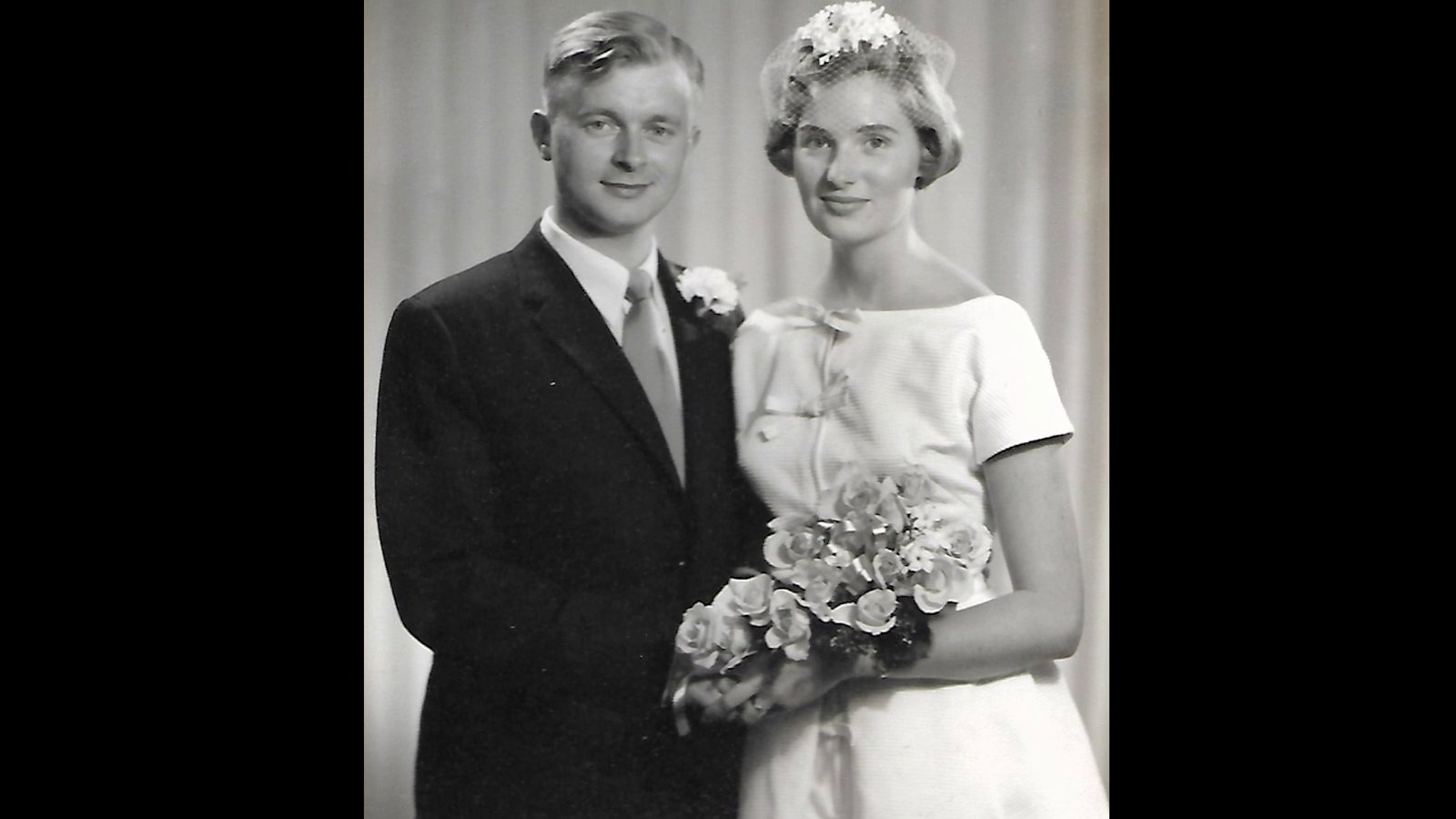
Tony and, very probably, Liz: a studio wedding portrait, c. July 1960. A frame from Michael’s funeral film (0:27); the original print has not yet been found.
A formal studio photograph of Tony in a dark suit with a carnation buttonhole and a bride in a short- sleeved, boat-necked white dress with a birdcage veil and a rose bouquet, against a draped backdrop.
- For Liz and July 1960: the dress and veil are of 1958–61; the groom is in his late twenties (Tony was 26); the bride’s face — long oval, high forehead, straight nose, mouth — matches Liz in the family portrait of c.1969–70 (funeral film, 0:41); and Michael, who had the family’s photographs and their account, put this picture on screen at the moment Liz says “we got married a couple of months later, really very very small wedding” (film, 31:17). [P], high.
- Against: Liz said there were no wedding photographs and found none in a box of loose prints (Liz). A studio portrait taken on another day, not on the wedding day at the town hall, would reconcile both. Tony’s first marriage (Rita) is the alternative, but he married her very young, and the styling is a decade too late for it. until the original print — and any studio stamp on the back — is found.